If you’re thinking about buying a home battery, there’s one question you probably want answered first: how long will it take to pay for itself?
That’s your battery’s payback period, and it’s a big part of working out your return on investment (ROI). But ROI isn’t just about earning back what you spent. It’s also about what your battery can save and earn over its lifetime, and the energy plan sitting behind it can make a big difference. Most home battery payback estimates are based on averages and assumptions about system size, energy use and solar exports. They can give you a rough idea, but they don’t necessarily tell you what a battery could look like for your household, particularly if they assume it will spend its life in standard self-consumption mode.
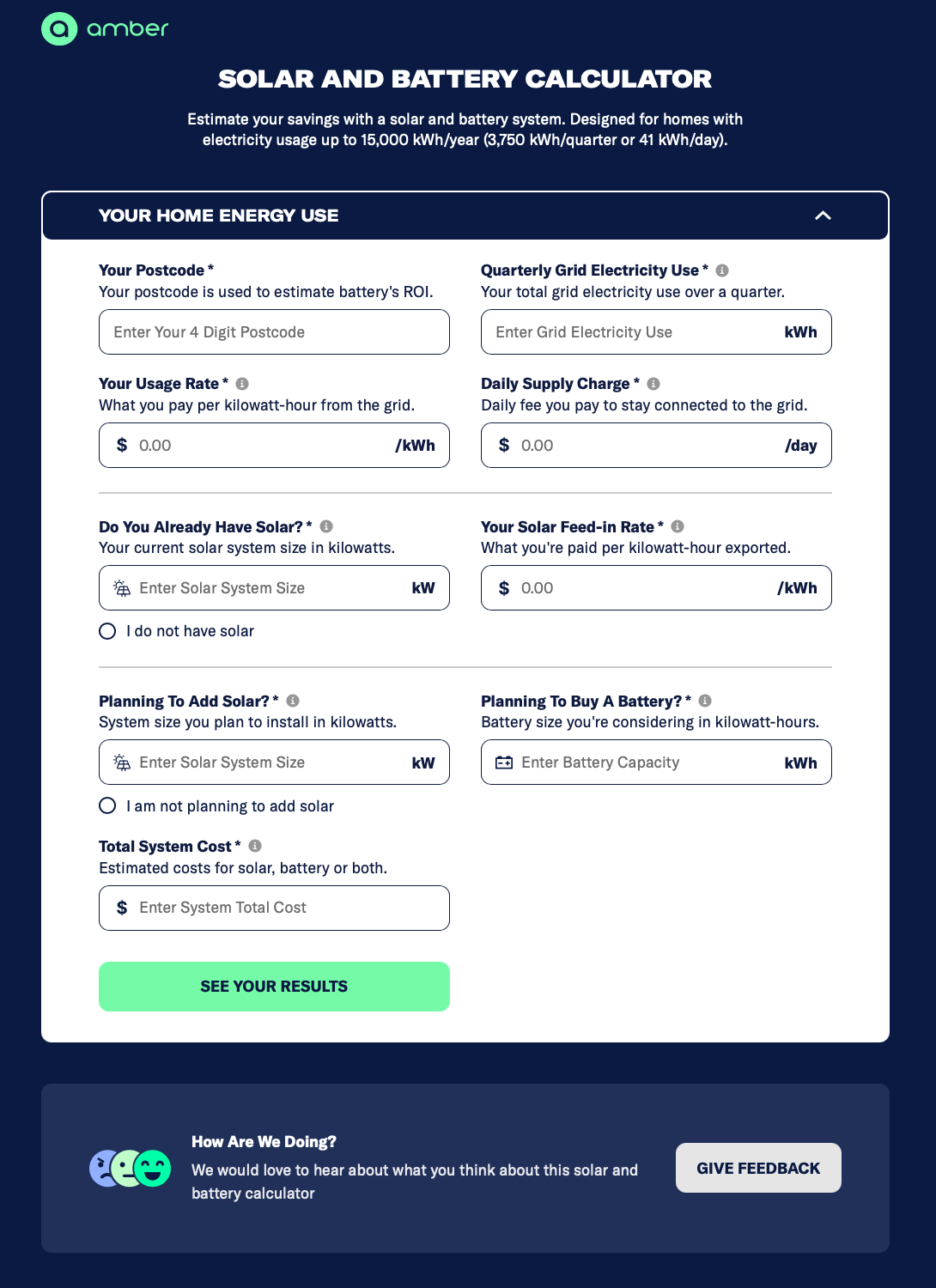
That’s why Amber built its ROI calculator. Enter your postcode, electricity usage and rates, solar system size, battery size and the cost of the system after rebates, and it estimates your payback based on your setup. It also factors in what your battery could earn with Amber and SmartShift, rather than assuming a flat feed-in tariff.
Your upfront cost is only part of the ROI
Start with what the battery actually costs you. There’s the battery itself, installation and any other system costs, minus the rebates you’re eligible for. That gives you your upfront investment.
But what happens after installation is just as important to your ROI. Put two identical batteries in two houses with the same solar panels and the same weather, but on different energy plans, and they will have very different payback periods. The plan decides what the battery is allowed to do with the energy it stores - whether it just cycles through your own home each day or gets used to trade on the market.
Self-consumption mode
Most batteries are set up in self-consumption mode. Solar charges the battery during the day, the house draws it down at night instead of buying from the grid. It does exactly what it's set up to do, and it will bring your bill down compared with having no battery at all.
However, the battery has no idea what the market is doing. It has no way of knowing that energy is about to become expensive in a few hours, or that right now, in the middle of the day, it's worth almost nothing. It just keeps to its routine, filling up while the sun's out and running the house down overnight, whether or not that's actually the best use for the energy it's holding.
On a traditional plan, that's rarely a loss, because the alternative isn't much better. Flat feed-in tariffs are typically only a few cents per kilowatt hour, so battery owners can often get more value from keeping that energy to power their own home later. At that rate, most battery owners are better off keeping the energy for their own home than sending it back to the grid for next to nothing.
The plan changes the payback maths
A traditional retailer buys wholesale energy, adds a markup, and sells it to you. The wider the gap between what they pay and what you pay, the more they make, which means there's no incentive for them to help your battery earn more. And because that markup can quietly widen the longer you stay on the same plan, the return you were promised when you bought the battery has a habit of shrinking.
Amber works differently. There's no markup on energy, in either direction. You pay the wholesale price when you buy, and your battery earns the wholesale price when it sells. Amber's only margin is a flat monthly subscription, so it doesn't change based on how much you use or export. That means Amber has no reason to keep your battery sitting on self-consumption mode instead of trading.
SmartShift, Amber's battery automation, watches the market and acts on it. It charges the battery when energy is cheap or free, holds that charge, and sells it back to the grid when prices spike, rather than on a fixed schedule. During peak periods, that can mean earning up to $19 a kilowatt hour for stored energy, and you keep all of it.
Amber's ROI calculator factors in that earning potential too. It models what your battery could earn trading on wholesale prices with Amber, alongside what you'd spend to install it, so the payback estimate reflects SmartShift's upside instead of a flat, average export rate.
Payback time isn't one fixed number
Even on the same plan, payback time isn't identical from house to house. How much solar you're already generating, how much of it you use during the day versus how much is left over to store, and how much you draw from the battery at night all shift the maths. A household that exports a lot of surplus solar has more for SmartShift to work with than one that's already using most of what it generates.
That's exactly why a generic payback figure, the kind you'll see quoted in a lot of solar marketing, isn't especially useful. It's an average built from assumptions about a household that probably isn't yours.
Getting a specific number for your household
Location plays a bigger part in this than people expect. Wholesale prices are more volatile in South Australia (where prices can reach $21 a kilowatt hour), which tends to mean bigger potential export earnings when prices spike. In states with more stable prices, payback can take a little longer, though the long-term savings still hold up. That's part of why the ROI calculator asks for your postcode. Since regional price differences change the estimate, and why two households with the same battery in different states can get quite different results.
Because payback depends on so many moving parts, your system size, your usage, your export potential and the plan behind it, working it out by hand is genuinely hard. That's what Amber's ROI calculator is built to help with. It's designed to estimate the return on investment you could see from solar and a battery, so you can make a decision based on numbers specific to your own setup.
Try it with your own numbers
The difference between a battery running on self-consumption and one trading on SmartShift is real, and it shows up directly in how quickly the system pays for itself and what it earns after that.
Head to our ROI calculator, and run your own numbers. It's the quickest way to see what your battery, or the one you're considering, could actually be worth.