
Australians installed an estimated 966.5 MWh of home batteries in September 2026, up 12.5% from August and the strongest month since April.
Australia is installing home batteries at an extraordinary rate. But the bigger opportunity is what happens once they're installed.
The battery rebate is driving record installs
The Australian Government's Cheaper Home Batteries Program launched in July 2025, offering eligible households around 30% off the upfront cost of installing a battery connected to solar.
The program has a budget of $7.2 billion over four years, helping make home batteries more accessible.
According to the Clean Energy Council's latest report, 457,439 batteries were installed in the program's first 12 months to June 2026. By August, installations under the program had passed half a million.
The first half of 2026 alone saw 276,011 home batteries installed, 52% more than the previous six months. In capacity terms, households added more than double the storage installed during the preceding six-month period.
Your battery can do more than store solar
Most households install a battery to store excess solar energy during the day and use it at night, reducing how much electricity they need to buy from the grid. But home batteries can do more than power the home.
When connected to wholesale electricity prices, they can charge when energy is cheap, avoid buying from the grid when prices are high and export stored energy when the grid needs it most. That creates opportunities for households to save on bills and earn from exports, while supporting the wider energy system.
The growing impact of home batteries
On 12 October 2026, Amber customers in NSW collectively earned $2.12 million exporting electricity to the grid in just 80 minutes. As The Energy reported, that was more than some of Australia's largest grid-scale batteries earned over a similar period. It showed what's possible when batteries respond to wholesale prices.
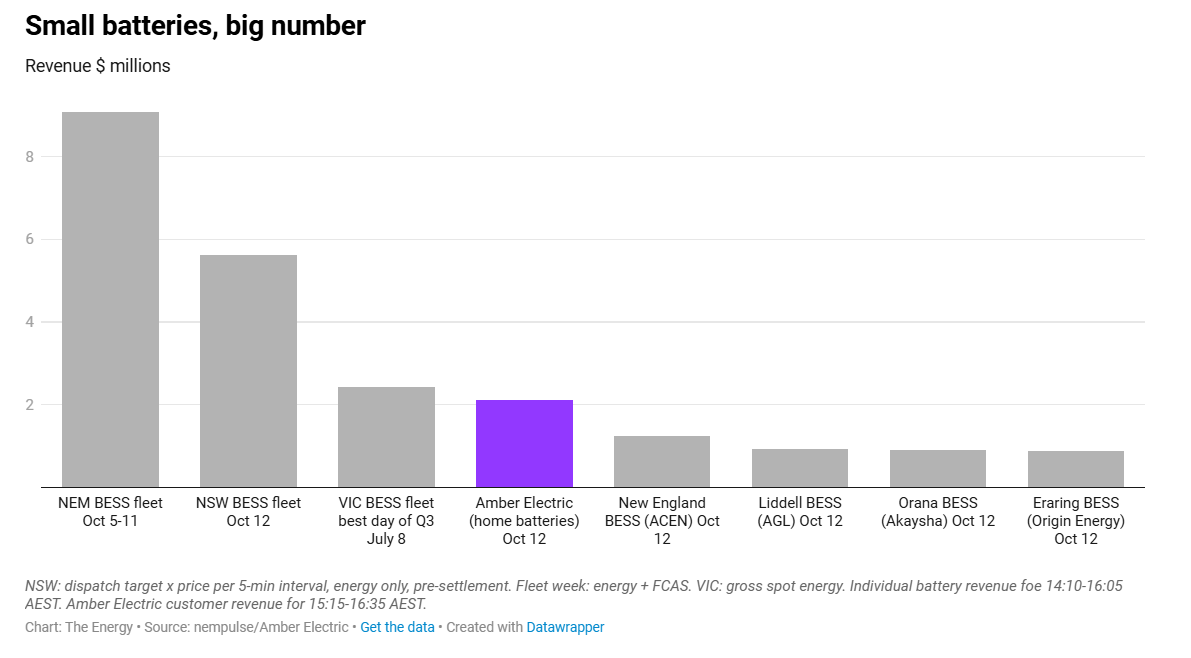
Source: The Energy / nempulse / Amber Electric. Revenue figures cover different time periods and measures, so comparisons are indicative rather than like-for-like.
Speaking to ABC News, our co-CEO Dan Adams explained that household batteries and EVs can now provide capacity during demand peaks that previously relied on gas generators.
Yet according to The Energy, fewer than one in four home batteries are enrolled in a virtual power plant (VPP), leaving much of Australia's installed battery capacity outside coordinated market participation.
How Amber helps you get more from your battery
Home batteries can deliver more value on a dedicated battery plan like Amber than on a standard energy plan.
On a traditional energy plan, households generally receive a fixed feed-in tariff for exported electricity, regardless of its wholesale value. Many VPPs offer fixed export payments in exchange for some control over when a battery exports. Amber's battery plan works differently.
We pass through wholesale electricity prices without adding a markup, charging a flat $25 monthly subscription instead. Customers keep 100% of their export earnings, including when wholesale prices spike.
SmartShift, our battery automation technology, helps customers make the most of those prices without having to monitor the market themselves. It uses forecast wholesale prices, expected solar generation and household energy needs to decide when to charge, store and export electricity, updating its plan every five minutes.
Customers can leave SmartShift to run automatically or override its decisions whenever they choose.
Ready to put your battery to work?
With hundreds of thousands of Australians investing in home batteries, choosing the right battery plan is just as important as choosing the battery itself.
Already have a battery? Check whether it's compatible with SmartShift, or get a quote with Amber to see how you could get more value from it.


