
Francis Clarke was one of the first Australians to use his EV as more than just a car. Three years into his V2G journey, he’s seen first-hand how an EV can power a home, reduce energy costs and even sell electricity back to the grid. Ahead of his presentation at the National Renewables in Agriculture Conference in Orange on 12 August 2026, Francis shares what he’s learned from being an early V2G user - and why he believes electric vehicles could play a much bigger role in Australia’s energy future.
Three years ago, when my power retailer dropped my feed in tariff to bugger all, I looked into buying a battery for my solar and found that the big battery in an EV was cheaper per kWh than a small stationary battery. You essentially get the wheels for free!
Essential Energy were kind enough to install a Bi-directional/two-way charger, the first in NSW. Amber Electric, my retailer, offered a very talented programmer to integrate my EV into their SmartShift program.
Amber charge a monthly subscription fee, after which all costs and sales are at wholesale rates, without markup. I buy and sell power at exactly the same price as AGL or Origin and supply into the national grid.
Selling power back to the grid has paid my power bills and powered my car (80,000km) for two years at zero cost. One evening I made $570 selling to grid during a spike and in May ’24, I made a profit of $800.
Essential Energy pay me a bonus feed-in of 11.72c/kW for selling power from 5-8pm, but this barely covers wear and tear on my battery.
Recently the coal burners have not been breaking down so there have been few power spikes and the batteries everybody is installing have reduced the need for expensive gas, so power prices have been low. Recently I have actually received bills for house power and 2,500km of monthly travel - at the cost of about one fill of petrol in an ICE car.
Amber have recently been funded for a trial of 1,000 EV’s and are using AI to develop a program to optimise least cost charging of EV’s and to automate when owners buy or sell power between car grid.
This graph shows my cumulative monthly power to and from the car in kWh. I can switch this to dollars bought and sold or even kilograms of Co2. That month my wife was picking grandchildren up from school so the EV was away during the day and could not charge with solar and had to be charged at night, so we bought quite lot of red power. Green and blue is vehicle-to-home (V2H) or grid (V2G).
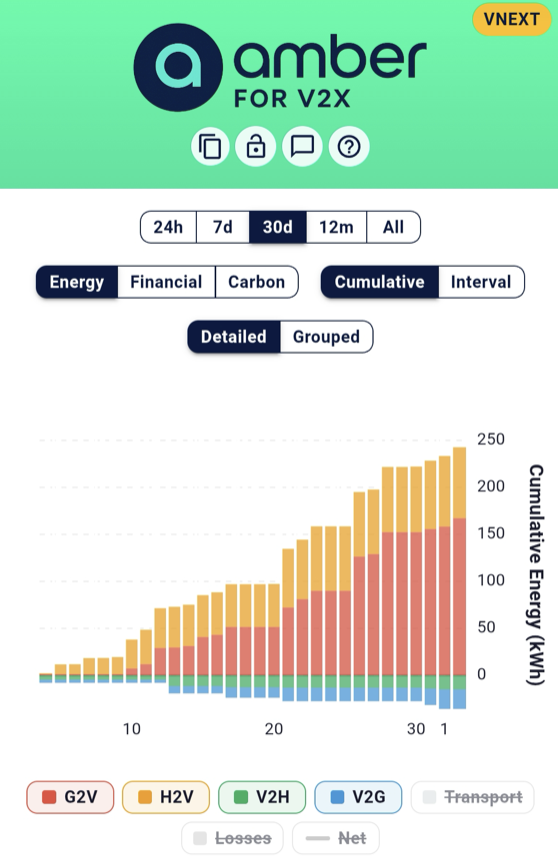
Aggregating these statistics for 1,000 owners will prove the value of the EV fleet in achieving net zero while reducing costs to EV owners.
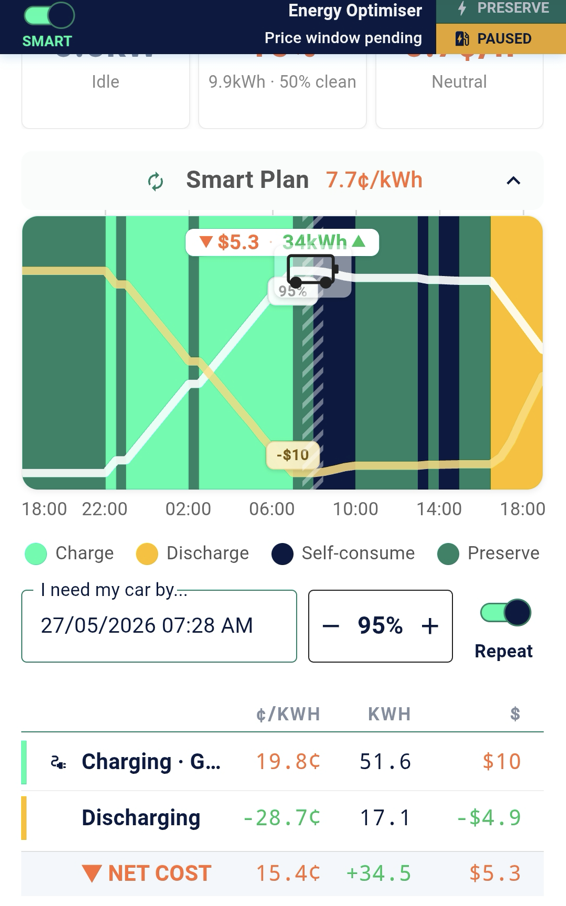
With my Smart Plan, all I have to do is enter when I need the car and the charge level - everything else is automated by Amber. In the below graph, the white line is charge level the yellow is cost:
My cows run on grass but my EV is quite capable of powering my shearing shed and pumps. With my solar, EV and battery I effectively supply power to my neighbours, when they need it. This requires no extra poles, wires, transformers or ugly HT power lines.
If Twiggy Forest can power his 100 Tonne iron ore trucks with batteries it won’t be long before big farm tractors are running on batteries. If you are planning to buy one be sure you can use the battery for other purposes.
The EV fleet and indeed electric tractors and plant, if connected via Bi-directional chargers could materially reduce the need for commercial renewable storage when we close down fossil fuel generators. At zero cost to taxpayers - all within our local community.
Australia leads the world. Let's lead in rooftop solar, let’s lead in selling EV and tractor power to the grid.


