
Welcome back to our monthly look under the bonnet of Australia's largest residential V2X trial. From mid-May to mid-June, the fleet tested a simple idea: can it still save money when wholesale prices stay flat? Short answer, yes.
Some months the grid throws up big price spikes and the cars cash in. This period didn't, so the fleet leaned on the other thing it's good at. Here's what it did, and why it still added up.
V2G program update
Last month, we made it official: Amber is expanding its V2G program from 50 to 1,000 Australian homes, backed by $13.6 million in ARENA funding. We announced it from the Lidcombe home of Amber customer Ken Chung, joined by Federal Minister for Climate Change and Energy Chris Bowen, ARENA CEO Darren Miller, Amber's Head of V2G Clare Rainbow, and more. With more than 7,000 Australians on the waitlist, V2G has moved from trial to mainstream. Read the full announcement here.
What happened across the fleet this month
June proved the fundamentals work even when the grid is quiet. Wholesale prices stayed relatively flat across the NEM and local solar generation was lower than usual due to the weather.
The pattern was straightforward: charge the car during the day, partly with rooftop solar, then use that stored energy to run the home in the evening instead of buying from the grid. That's V2H, or Vehicle to Home and it did most of the heavy lifting - 72% of all energy discharged from vehicles delivered value this way.
The grid was quiet. The savings weren't.
Here’s an example of one household in NSW:
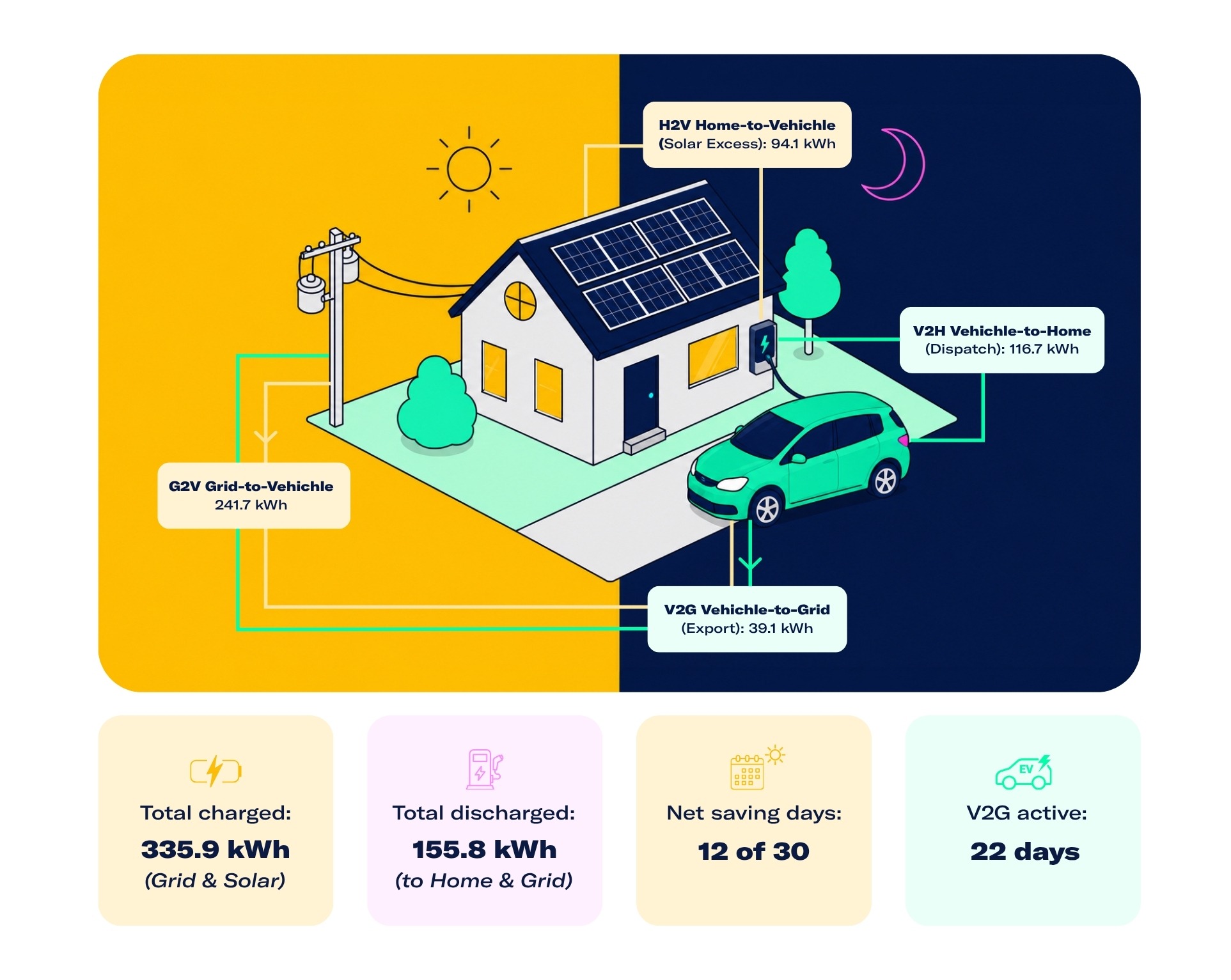
The numbers
- Fleet size: 33 vehicles
- Period: 12 May - 11 June 2026
Energy in, energy out
- Total charged into vehicles: 8,763.6 kWh All the energy that flowed into EV batteries over the 30 days - 6,102.1 kWh from the grid and 2,661.5 kWh from home energy sources, mostly rooftop solar
- Total discharged from vehicles: 2,335.5 kWh Energy that flowed back out of EV batteries for useful purposes - 1,680.0 kWh powering homes via V2H, and 655.5 kWh sent back to the grid via V2G
What it means in dollars
- Gross charging cost: $1,237.82 What it cost to charge the batteries in the first place - $992.21 in grid electricity and $245.61 representing the opportunity cost of home solar used to charge cars rather than being exported
- Value returned via V2H + V2G: $567.74 The financial benefit of using that stored energy smartly. $423.25 came from avoiding grid electricity purchases through V2H, and $144.49 was earned from grid exports via V2G
- Net fleet cost: $752.10 After V2X savings are applied, that's the net cost to run the fleet's EVs for the month
Our learnings
V2H led this month - 72% of all energy discharged from vehicles went straight back into powering homes. The solar-charges-the-car, car-powers-the-home-at-night pattern isn't just working - it's becoming the dominant use case.
Grid conditions shaped the result - A quieter grid with flat wholesale prices and lower solar generation meant fewer opportunities for high-value exports. The net cost figure reflects that - this month was about load shifting, not export earnings.
What we're watching
With 33 vehicles now connected and the trial scaling toward 1,000 homes, we're watching for what happens when grid stress picks up. That's when V2G gets to flex - cars export energy at high prices, customers earn more and the grid gets help exactly when it needs it.
This month was steady: over $567 of value generated from energy already sitting in people's cars. The fundamentals are solid, and the fleet is only going to grow from here.
We're proud to be running the largest residential V2X trial in Australia, and prouder still that it's real customers like Ken proving it works. If you want to be part of it, join the waitlist and we'll be in touch as we scale.


